What Do Snapchat Planets Mean? The Complete Order Guide (2025)
So you opened a friend’s profile on Snapchat, spotted a little glowing planet badge, and now you’re wondering — what does that actually mean? You’re not alone. Millions of users see these planet icons every day and have no idea whether they landed on Mercury or got banished to Neptune.
Here’s the short answer: Snapchat planets show your rank in someone’s Best Friends list. The closer the planet is to the Sun, the more you two interact.
That’s the concept. But there’s more nuance worth knowing — especially if you’re curious about where you stand with the people who matter most to you.
What Are Snapchat Planets, Exactly?
Snapchat planets are part of the Friends Solar System, a visual feature exclusive to Snapchat Plus subscribers. Instead of a plain list of best friends, Snapchat turns your social circle into a miniature galaxy.
Here’s how it works:
- You are the Sun — the center of your own solar system.
- Your eight closest friends become the planets orbiting around you.
- The closer the planet to the Sun, the higher that friend ranks in your interactions.
The ranking is based on how frequently you exchange snaps and chats. It’s essentially a visual snapshot of who you talk to most, presented in a surprisingly charming cosmic format.
How to View Your Snapchat Planets
Before you go hunting for planets, know this: the feature requires Snapchat Plus, which is Snapchat’s paid subscription tier.
Once you’re subscribed:
- Open the Snapchat app and go to a friend’s profile.
- Look for the “Best Friends” or “Friends” badge near their name.
- Tap the badge.
- The Friends Solar System screen will pop up, showing which planet you are in their universe.
The app labels each planet clearly, so you won’t need to guess based on color alone. Your position is displayed right there, no interpretation required.
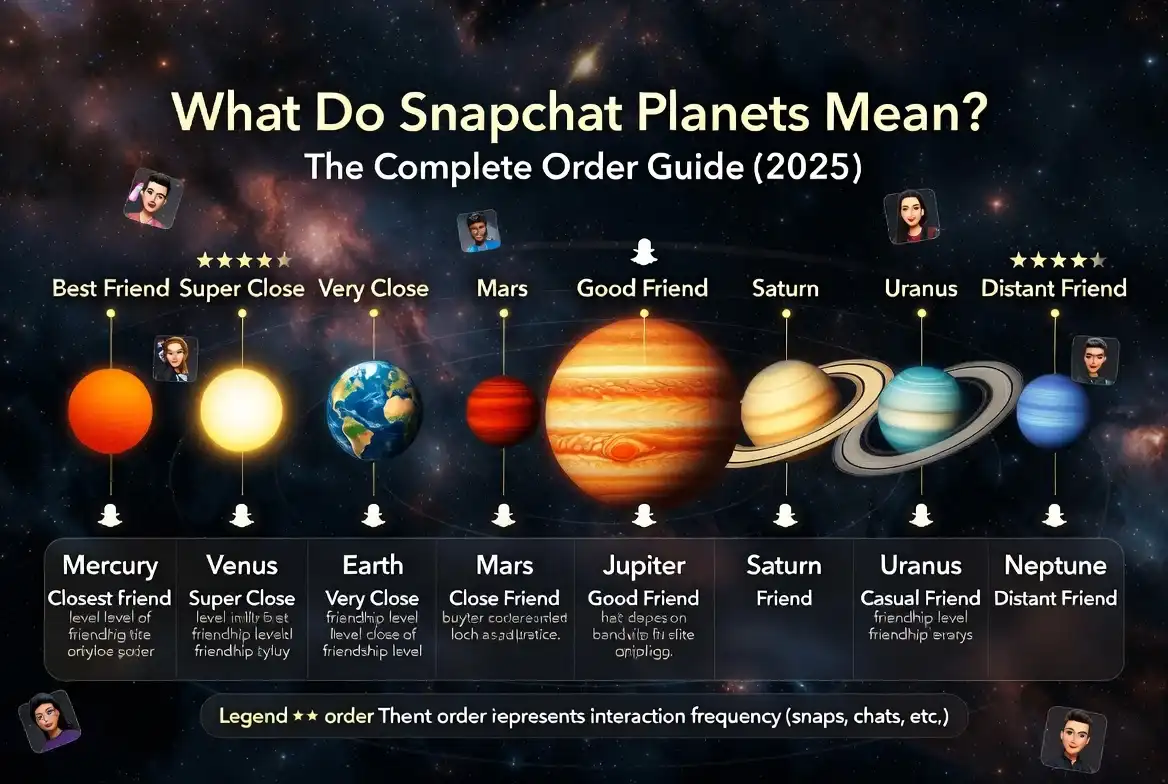
The Complete Snapchat Planets Order — All 8 Planets Explained
The planet order mirrors our real solar system — from Mercury closest to the Sun, all the way out to Neptune. Each position corresponds to a friendship rank, from #1 down to #8.
🪨 Mercury — #1 Best Friend
Mercury is the golden ticket. If someone’s Mercury is you, you are their most-contacted person on Snapchat. Full stop. You’re the first person they reach for when something funny, sad, or random happens. It’s the highest honor the solar system can hand out.
Visual: Small, gray, rocky planet — humble looking, but the most prestigious spot on the list.
🌕 Venus — #2 Best Friend
Venus means you’re close — genuinely close. You might not top their list, but you’re solidly in their inner circle. This person probably shares a lot with you, just ever so slightly less than their Mercury friend.
Visual: Warm yellow planet with a soft, glowing appearance.
🌍 Earth — #3 Best Friend
Landing on Earth means you’re a consistent, trusted presence in someone’s digital life. Not quite the top two, but absolutely in the conversation. Snapchat also adds a tiny moon orbiting the Earth icon, which is a cute touch.
Visual: Familiar blue and green globe — hard to miss.
🔴 Mars — #4 Best Friend
Mars represents a solid friendship that’s slightly less active than the top three. You’re still part of someone’s go-to group, but the frequency of your interactions is a notch lower. Think of it as being a reliable friend rather than a daily one.
Visual: Reddish-orange rocky planet.
🟤 Jupiter — #5 Best Friend
Jupiter marks the beginning of the outer planets — but don’t take that personally. Making it onto someone’s Best Friends list at all means you’re among their top eight out of potentially hundreds of contacts. Jupiter holders are still valued; the competition just gets steeper toward the middle.
Visual: Large, beige planet with faint stripes.
🪐 Saturn — #6 Best Friend
Saturn is instantly recognizable thanks to its rings. If you’re someone’s Saturn, you’re still a regular part of their Snapchat activity, just not at the forefront. The rings make this one of the most visually distinct planets on the list.
Visual: Beige planet with a prominent ring system.
🔵 Uranus — #7 Best Friend
Uranus sits near the outer edge of someone’s social solar system. You’re in the top eight — which is genuinely something — but your interaction frequency puts you toward the back of the pack. Consistency could easily bump you inward.
Visual: Cyan-toned, slightly tilted planet.
🌑 Neptune — #8 Best Friend
Neptune is the furthest point in the solar system, and on Snapchat, it represents the eighth and final Best Friends slot. You made the list, which matters. But if you want to move closer to the Sun, you know what to do: send more snaps.
Visual: Deep navy blue planet.
Quick Reference: Snapchat Planets Order at a Glance
| Rank | Planet | Visual Clue | What It Means |
| 1st | Mercury | Small gray rock | Top best friend |
| 2nd | Venus | Yellow, glowing | Second best friend |
| 3rd | Earth | Blue/green + moon | Third best friend |
| 4th | Mars | Red/orange | Fourth best friend |
| 5th | Jupiter | Large, beige striped | Fifth best friend |
| 6th | Saturn | Beige with rings | Sixth best friend |
| 7th | Uranus | Cyan, tilted | Seventh best friend |
| 8th | Neptune | Dark navy blue | Eighth best friend |
What If You Don’t Have Snapchat Plus?
Free accounts don’t see the planet system. Instead, Snapchat uses a set of emoji icons to signal friendship levels — things like a yellow heart for #1 best friend or a red heart for a mutual best friend over time.
The underlying ranking logic is identical. Snapchat Plus just swaps the emojis for a far more visual (and frankly more fun) solar system experience.
If you’re on a free account and want the planet feature, you’ll need to upgrade. Whether that’s worth $3.99/month is a personal call — but if you’re the kind of person who reads a full guide about Snapchat planet rankings, you probably already know the answer.
Do Snapchat Planets Update in Real Time?
Not exactly in real time, but they do update regularly based on your recent messaging habits. If you’ve been snapping someone constantly for the past few weeks and then go quiet, your planet position will drift outward. On the flip side, increase your interactions and you’ll move closer to the Sun.
The system rewards consistency. It’s less about a single big conversation and more about showing up regularly.
What Does Being Someone is Mercury Mean?
It means you’re their most frequent Snapchat contact. In practical terms, it usually signals a very close friendship — a best friend, a partner, a sibling, or someone you just genuinely enjoy talking to all day.
Some people place a lot of weight on the Mercury spot. Others treat the whole thing more casually. Either way, the feature gives you a clear, honest read on where you stand — which is both reassuring and occasionally humbling.
Can Both People Be Each Other’s Mercury?
Yes, absolutely. If you’re each other’s top contact, you’ll both appear as Mercury on each other’s solar systems. It’s mutual, and it’s as wholesome as the internet gets.
Common Questions About Snapchat Planets
Does the planet system track streaks? No. Streak counts are separate. Planets are based on overall messaging frequency, not whether you’ve maintained a daily streak.
Can someone hide their planets from you? The badge visibility is tied to whether you’re on their Best Friends list. If you don’t appear as one of their top eight contacts, you won’t see a planet at all — you’ll see a generic “Friends” badge instead.
Is the Snapchat planets feature available everywhere? It’s available wherever Snapchat Plus is offered, which covers most major markets. If you can subscribe, you can access it.
Why does my planet keep changing? Your rank shifts based on recent activity. Snapchat recalculates best friends over a rolling time window, so today’s Mercury can become next week’s Venus if another friend starts snapping you more.
Final Thoughts
Snapchat’s planet system is a surprisingly clever way to visualize something most social apps keep abstract — how close you actually are to the people in your contacts. Whether you’re thrilled to be someone’s Mercury or gently motivated to climb up from Neptune, it turns digital friendship into something you can actually see.
If you found this guide useful, share it with your group chat. Chances are at least one person in there is wondering what their planet means too.Last updated: 2025 | For official feature details, visit the Snapchat Support Center.