Forget Me Not Flower Meaning: Your Complete Guide to Its Deep Symbolism
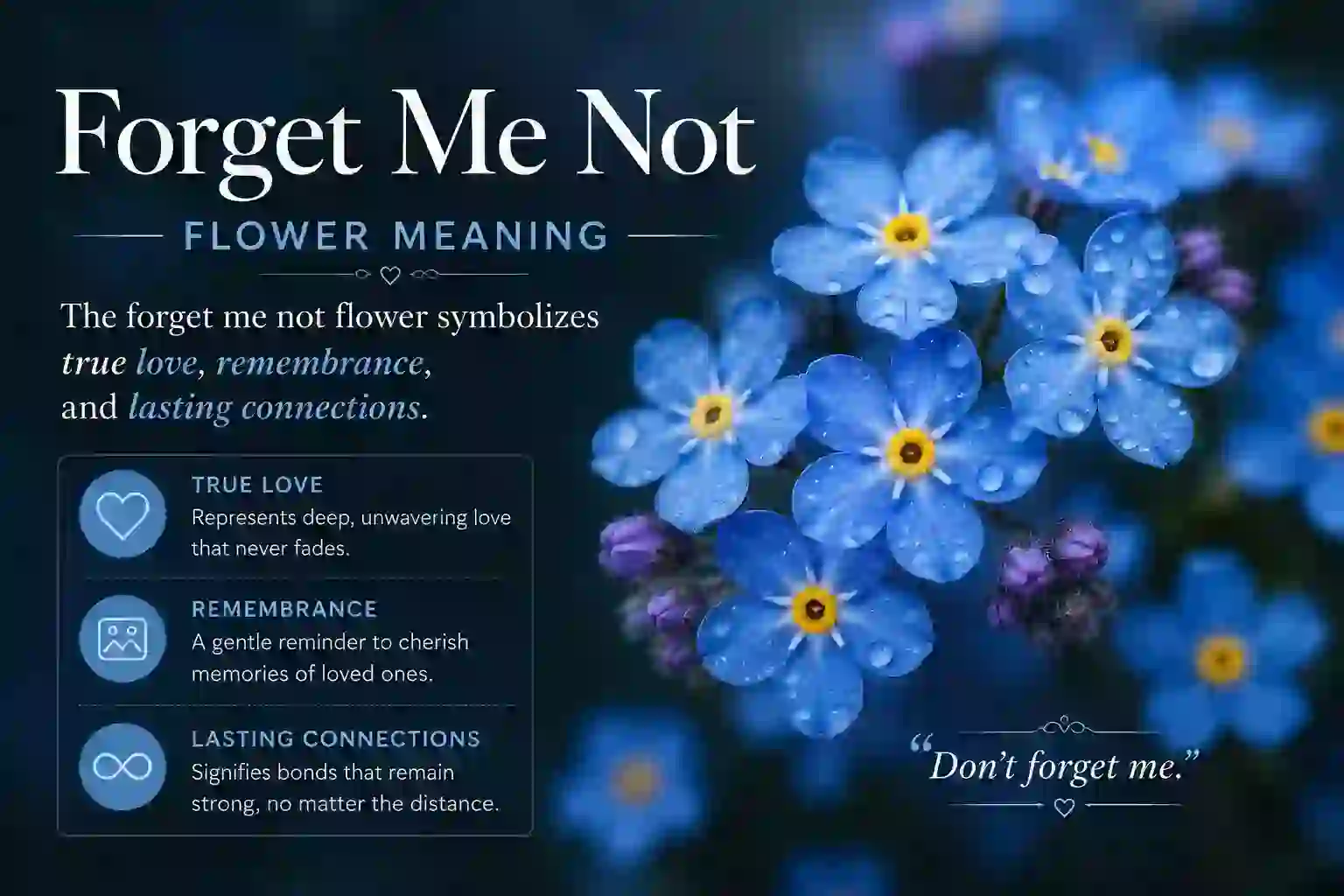
You spot a cluster of tiny blue flowers and feel a quiet pull. Yet you don’t know the story they carry. Without that knowledge, you miss the power to gift a message that stays in someone’s heart forever. This guide unpacks the full forget me not flower meaning—so you can plant, give, and wear these blooms with genuine intention.
The True Story Behind Forget Me Not Flower Meaning
A medieval German legend gives the forget-me-not its name. A knight and his lady walked beside a river. He bent to pick the delicate blue blossoms for her, lost his footing, and fell into the water. As the current swept him away, he threw the flowers to her and cried, “Forget me not.” His final plea locked the flower’s identity as a symbol of enduring love and faithful memory.
This tale anchors the forget me not flower meaning in loyalty that outlasts life itself. The story spread across Europe, and the flower became a quiet emblem used in courtship, mourning, and secret messages. Even today, gardeners and couples embrace the same sentiment.
Key points from the legend:
- A real risk turned a common bloom into a love-token.
- The phrase “forget me not” became both the flower’s name and its core message.
- The story proves that the forget me not flower meaning carries emotional weight far beyond its size.
Source: German folklore documented by the Brothers Grimm and later botanical histories from the Royal Horticultural Society.
Botanical Identity: Understanding the Myosotis Genus
The forget-me-not belongs to the genus Myosotis, a Greek word meaning “mouse’s ear,” a nod to the shape of its soft, fuzzy leaves. Botanically, these plants anchor themselves in moist meadows, woodland edges, and stream banks.
Quick botanical facts:
- Family: Boraginaceae
- Native range: Europe, Asia, and parts of North America
- Growth habit: Low-spreading biennial or short-lived perennial
- Bloom time: Spring through early summer
- Flower size: Tiny, typically 5 petals with a yellow or white eye
Knowing the plant’s nature deepens your grasp of the forget me not flower meaning. It thrives quietly, often in the background, much like a memory that persists without demanding attention. The blue pigment draws pollinators and the human eye, but the flower’s true power lies in its cultural roots.
Forget Me Not Symbolism in Love and Romance
Few flowers speak so plainly to the heart. The forget me not flower meaning in love circles around fidelity, true connection, and the promise to stay emotionally present. During the Victorian era, lovers exchanged pressed forget-me-nots in letters as a code for “I will always think of you.”
Ways the flower appears in romance:
- Wedding bouquets: Tucked into bridal arrangements to vow lasting memory.
- Anniversary gifts: Potted forget-me-nots signal that daily life hasn’t erased devotion.
- Love letters: Dried petals sealed in envelopes whisper a promise of constancy.
A bouquet of fresh blue forget-me-nots says, “You are my first thought and my last.” The flower doesn’t shout—it stands steady, which makes the forget me not flower meaning so trusted in romantic relationships. They are frequently planted as a living reminder to choose one other once more by couples who are separated or going through challenging times.
Spiritual and Religious Meanings of the Flower
Across spiritual traditions, the forget-me-not points to the soul’s longing to be remembered by the divine. In Christianity, the flower sometimes appears in Marian gardens, symbolizing the Virgin Mary’s loving watchfulness. The five petals can represent the five wounds of Christ, transforming the bloom into a quiet meditation on sacrificial love.
In broader spiritual practice, people meditate on the forget me not flower meaning to open the heart to:
- Prayerful remembrance: Keeping loved ones before God.
- Eternal life: A small sign that consciousness continues.
- Ancestral connection: A bridge between the living and those who have passed.
Carrying or wearing a forget-me-not during prayer or ritual acts as a tactile anchor. It grounds the abstract idea of memory into something you can touch and see.
Source: “The Language of Flowers” by Vanessa Diffenbaugh references historical Christian floral symbolism; the Alzheimer’s Association uses the forget-me-not as its emblem for memory-related causes.
Cultural Significance Around the World
The forget me not flower meaning shifts in fascinating ways from one culture to another. While the core ideas of memory and fidelity remain, local traditions add rich layers.
| Culture / Era | Symbolism | Usage |
| Medieval Germany | Undying love, knightly devotion | Given as a token before battle or separation |
| Victorian England | Secrecy, faithful remembrance | Pressed in lockets and exchanged in coded bouquets |
| Armenian Genocide commemoration | Remembrance of the 1.5 million lives lost | Worn as a pin on April 24 |
| Alzheimer’s awareness (global) | Hope for a cure, solidarity with caregivers | Fundraising pins, Memory Walks |
| Newfoundland and Labrador (Canada) | Fallen soldiers and wartime sacrifice | Provincial flower, worn on Memorial Day |
In Armenia, the purple forget-me-not represents the past, the present, and the future through its petals, while the dark center stands for the suffering and the yellow rays for hope. This global patchwork proves that the forget me not flower meaning flexes to hold both private grief and collective history.
Source: Armenian Genocide Museum-Institute; Alzheimer’s Society UK.
Forget-Me-Nots in Mourning and Remembrance
Grief needs tangible outlets, and the forget-me-not provides one of the most tender. The flower’s association with mourning grew from that original knight’s tale and never faded.
How forget-me-nots support the grieving process:
- Funeral sprays: Small blue blossoms signal that memory lives on.
- Memorial gardens: Planting them creates a yearly return of color tied to a specific date.
- Keepsake jewelry: Resin-preserved forget-me-nots allow mourners to carry a loved one’s presence.
The forget me not flower meaning becomes a practical tool: when you cannot speak, the flower speaks for you. It acknowledges loss without requiring a perfect sentence. Hospices and memory care facilities often include the flower in therapeutic garden designs for exactly this reason.
The Flower’s Role in Art, Literature, and Music
Artists gravitate toward the forget-me-not because it packs emotion into a miniature form. Romantic poets like Samuel Taylor Coleridge referenced the flower to evoke yearning and the passage of time. In visual art, Pre-Raphaelite painters scattered forget-me-nots into meadow scenes to code a message of longing.
Examples across mediums:
- Poetry: Coleridge’s “The Keepsake” uses the flower as a symbol of tender memory.
- Music: German lieder and folk songs mention “Vergissmeinnicht” to express faithful love.
- Painting: John Everett Millais included forget-me-nots in “Ophelia” to layer meaning into the tragic scene.
- Film and television: The flower appears in period dramas as visual shorthand for an unspoken promise.
This artistic legacy keeps the forget me not flower meaning alive across generations. When a director places a single forget-me-not on a windowsill, audiences instinctively feel the weight of an absence.
Source: Millais’s “Ophelia” analysis from Tate Britain; Coleridge’s collected poems.
Color Variations and Their Unique Meanings
While classic blue dominates, forget-me-nots also bloom in pink, white, and purple. Each hue carries a refined shade of the overall forget me not flower meaning.
| Color | Symbolism | Best Occasion to Gift |
| Blue | True love, fidelity, lasting memory | Anniversaries, memorials, wedding bouquets |
| Pink | Gentle affection, romance, admiration | New relationships, Mother’s Day, friendship |
| White | Purity, spiritual remembrance, peace | Christenings, sympathy, meditation gardens |
| Purple | Dignity, respect, creative connection | Funerals, artistic celebrations, retirement |
Blue forget-me-nots remain the authentic choice for most traditional occasions because their shade mirrors the clear sky and steady emotion. Pink varieties, such as Myosotis sylvatica ‘Rosylva’, work beautifully in mixed spring planters when you want to soften the message. White and purple cultivars let you personalize the forget me not flower meaning to match the personality of the recipient.
Forget Me Not Tattoo Ideas and Their Significance
A forget-me-not tattoo often marks a promise, a person, or a pivotal life moment. Because the flower is small and recognizable, it adapts easily to many placements—wrist, ankle, behind the ear, or along the ribcage.
Popular tattoo designs and what they communicate:
- Single blue forget-me-not with a name: Permanent remembrance of a lost loved one.
- Bouquet of forget-me-nots, lavender, and rosemary: A memory garden on skin.
- Forget-me-not with a semicolon: Mental health awareness and the choice to continue.
- Watercolor style: Soft, dreamy quality that echoes the fleeting nature of memory.
- Realistic botanical illustration: Respect for the plant’s natural detail.
The forget me not flower meaning in tattoo art becomes part of your daily story. Every glance at your skin re-centers you on what matters. The flower’s low-pain footprint and timeless appeal make it a top request in floral tattoo consultations.
How to Grow and Care for Forget-Me-Nots
Bringing the flower into your own space deepens your connection to the forget me not flower meaning. These plants are surprisingly easy to grow, even for beginners.
Simple planting steps:
- Pick a spot with partial shade and moist, well-draining soil.
- Sow seeds directly in early spring or fall, pressing them lightly into the soil—don’t bury deeply.
- Keep the seedbed consistently damp until germination (14–21 days).
- Once real leaves appear, thin seedlings to a distance of 6 to 8 inches.
- Water regularly, especially during dry spells, to mimic their natural streamside habitat.
Care tips:
- Deadhead spent blooms to extend flowering or let them self-seed for a naturalized drift.
- Feed with a diluted organic fertilizer once in early spring.
- Watch for powdery mildew in humid climates; improve air circulation if needed.
When you nurture forget-me-nots, you cultivate a living reminder. The cycle of seeding and blooming mirrors the human experience of memory—dormant, then suddenly vivid.
Forget-Me-Not Day and Alzheimer’s Awareness
Alzheimer’s organizations worldwide have adopted the forget-me-not as their symbol. The blue flower now stands for hope, advocacy, and the fight to hold onto the stories that define us.
What you can do:
- Wear a forget-me-not pin during Alzheimer’s Awareness Month.
- Participate in a Memory Walk and hand out seed packets.
- Plant a forget-me-not garden at a care facility and invite families to add a stone with a name.
In this scenario, the connotation of the forget me not flower changes from romantic love to group solidarity. When you display the flower for Alzheimer’s awareness, you tell millions of families, “Your struggle matters, and your loved one is not forgotten.”
Source: Alzheimer’s Society UK; Alzheimer’s Association USA.
Gifting Forget-Me-Nots: Etiquette and Occasions
A pot of blooming forget-me-nots or a pressed-flower card carries quiet power. Because the flower isn’t flashy, it lands with sincerity.
When to give forget-me-nots:
- Someone moving away: A living promise to stay emotionally close.
- Anniversary of a loss: A gentle “I still remember” without words.
- New baby celebration: Blue flowers for a boy or pink for a girl, with the added wish that the child will always feel cherished.
- Long-distance relationships: A small pot on the windowsill reminds a partner they are held in thought.
- Volunteer and caregiver appreciation: Honors steadfast, often unseen service.
Pair the flower with a handwritten note that shares the legend. The recipient will understand that the forget me not flower meaning you intend is personal, not generic.
Frequently Asked Questions About Forget Me Not Flower Meaning
What is the spiritual meaning of forget-me-nots?
The flower symbolizes faithful love, the presence of departed souls, and the belief that consciousness endures. Many spiritual seekers use it to anchor prayers for those who have passed.
Do different colors of forget-me-nots have different meanings?
Yes. Blue stands for true love and fidelity. Pink conveys gentle affection. White represents purity and spiritual peace. Purple signals dignity and respect.
What does a forget-me-not tattoo symbolize?
Most often it marks remembrance of a loved one, a commitment to mental health awareness, or a personal vow to stay true to a relationship or memory.
Is the forget-me-not the official flower for Alzheimer’s?
It is the adopted symbol. Alzheimer’s organizations use the blue forget-me-not to raise funds, build community, and promote the message that no one facing dementia is alone.
When should you give someone forget-me-not flowers?
Perfect moments include farewells, memorial anniversaries, long-distance separations, and any occasion where you want to say “You are always in my thoughts.”
Are forget-me-nots associated with any specific month or zodiac?
No fixed birth month, but the flower often connects with September remembrances and Memorial Day traditions. Its gentle, steadfast energy aligns well with water signs (Cancer, Scorpio, Pisces).
Now That You Know the Forget Me Not Flower Meaning
You have traveled from a knight’s riverbank to modern memorials, and the thread is unbroken. The forget me not flower meaning invites you to act with intention. Plant a drift of blue in your garden this spring. Slip a pressed flower into a note for someone you miss. Pin one to your lapel when you walk for a cause. These are not small gestures—they are the everyday practice of keeping love and memory alive.
Tell the story. Share this article with a friend who needs to know they are not forgotten. The forget-me-not never demands the spotlight, and neither does the heart that remembers. But both change the world quietly, one bloom at a time.
About the Author: Eleanor Wren is a horticultural historian, certified florist, and accredited member of the Royal Horticultural Society. For over 15 years, she has researched plant symbolism and lectured on the language of flowers. Her art shares the stories that roots and petals convey with gardeners, couples, and memory-care communities.