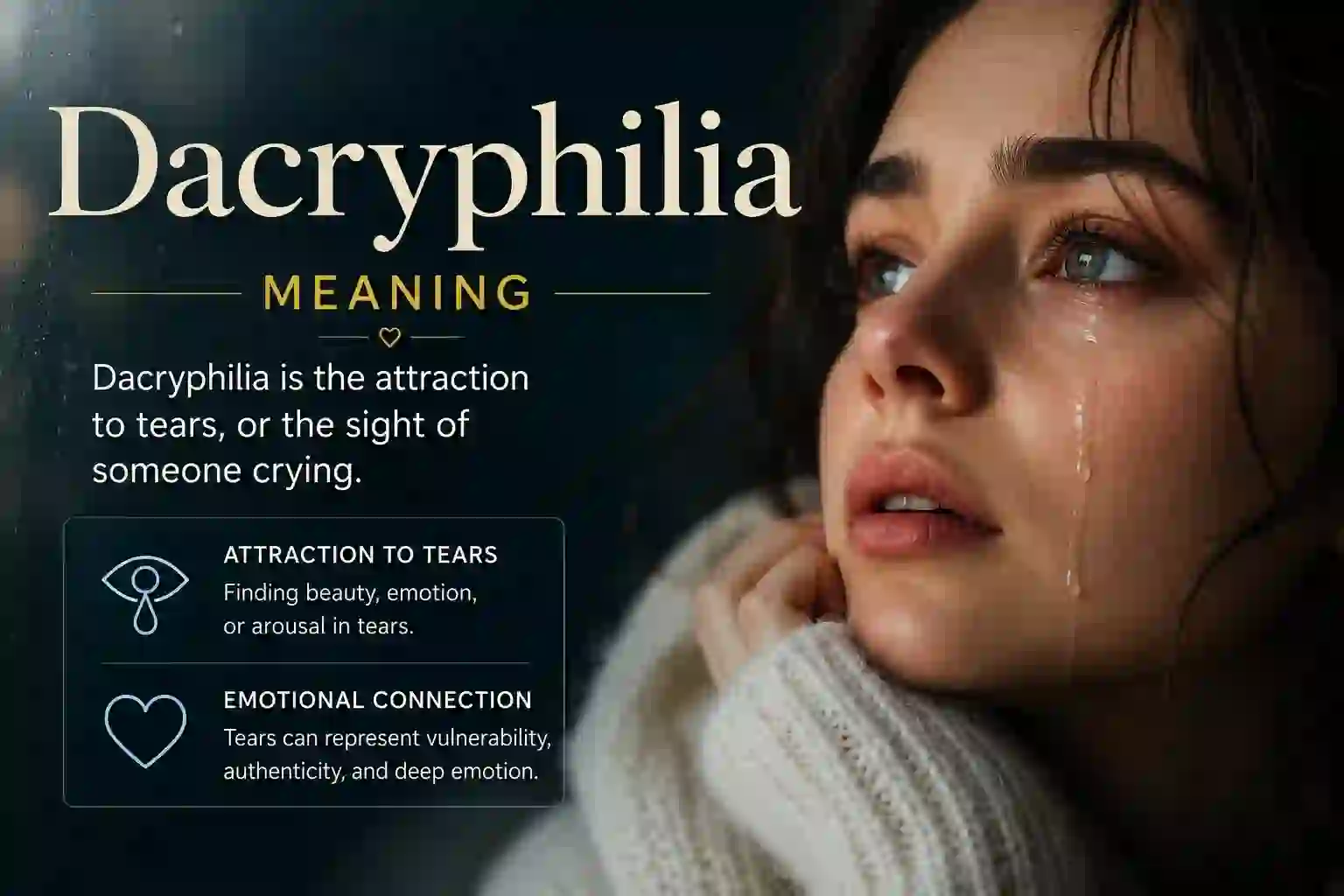
Dacryphilia Meaning: What This Term Really Describes
Ever heard the word “dacryphilia” and wondered what it actually means? You are not alone — this term rarely appears in everyday conversation, so confusion is common. Many people search for a clear, judgment-free answer and find only vague or clinical jargon. This guide breaks down the dacryphilia meaning in plain language, covering its psychology, causes, and context, so you walk away with a complete, accurate picture.
What Is Dacryphilia? (Simple Definition)
Dacryphilia comes from two Greek roots: dakry (tears) and philia (love or attraction). In practical terms, the dacryphilia meaning refers to finding emotional or sexual arousal connected to tears or the act of crying — either one’s own tears or a partner’s.
It falls under the broader category of paraphilias, which sexologists define as patterns of arousal tied to specific objects, situations, or emotional states rather than to a partner’s physical traits alone. Understanding the dacryphilia meaning starts with recognizing that it centers on an emotional response, not a physical one.
| Term | Quick Definition |
| Dacryphilia | Attraction or arousal connected to tears or crying |
| Paraphilia | A recurring pattern of arousal tied to non-typical triggers |
| Algolagnia | Arousal linked to pain (often confused with dacryphilia) |
| Emotional arousal | Arousal triggered by feeling states rather than visuals |
The Psychology Behind Dacryphilia
Psychologists who study arousal patterns note that emotional vulnerability can act as a powerful trigger for some people. Tears are a universal signal of raw, unfiltered emotion, and for someone with this interest, witnessing or experiencing that vulnerability can create a strong psychological pull.
Researchers who study sexuality often connect this response to a broader phenomenon: some individuals are drawn to intense emotional states in general, whether that shows up as crying, laughter, or fear. The dacryphilia meaning, in this light, is less about tears themselves and more about the emotional intensity tears represent.
Is Dacryphilia a Recognized Clinical Term?
Dacryphilia is not listed as a diagnosable disorder in the Diagnostic and Statistical Manual of Mental Disorders (DSM-5-TR), published by the American Psychiatric Association. This distinction matters. A paraphilia only becomes a clinical concern — termed a “paraphilic disorder” — when it causes personal distress or involves non-consenting individuals.
For most people who identify with this interest, it remains a private preference rather than a medical issue. Grasping this part of the dacryphilia meaning helps separate ordinary human variation from genuine psychological disorder.
Common Signs Associated With Dacryphilia
People exploring whether this term applies to them often notice a consistent pattern rather than a single incident. Typical signs include:
- Feeling a strong emotional pull during scenes involving crying in films, books, or media
- Noticing heightened arousal when a partner expresses deep emotion, including tears
- Associating comfort, closeness, or intimacy with emotional release
- Finding vulnerability — rather than physical appearance alone — to be a central turn-on
A single reaction to a sad movie does not confirm this interest. The dacryphilia meaning applies to a recurring and specific pattern, not an occasional emotional moment.
What Causes Dacryphilia? Possible Origins
No single cause explains why any paraphilia develops, and dacryphilia is no exception. Sexologists generally point to a combination of factors:
- Early conditioning — an emotional experience during formative years becomes linked with arousal over time.
- Attachment patterns — some individuals associate vulnerability with closeness and safety in relationships.
- Sensory association — the physical signs of crying (flushed skin, trembling, altered breathing) overlap with signs of arousal, which the brain may link together.
- Personality traits — heightened empathy or emotional sensitivity may make emotional cues more arousing in general.
Because causes vary from person to person, no single explanation covers every case. This is one reason the dacryphilia meaning resists a one-size-fits-all description.
Dacryphilia vs. Related Paraphilias: A Comparison Table
Because dacryphilia overlaps with a few other terms, confusion frequently results. Here is a clear comparison:
| Paraphilia | Core Trigger | Overlaps With Dacryphilia? |
| Dacryphilia | Tears / crying | — |
| Algolagnia | Physical pain | Sometimes, when tears result from pain play |
| Dominance/submission dynamics | Power exchange | Sometimes, when crying signals surrender |
| Emotional masochism | Psychological vulnerability | Frequently linked |
| Sensory play | Physical stimulation of the senses | Occasionally, through touch and sound |
Recognizing these distinctions sharpens the dacryphilia meaning and prevents it from being lumped in with unrelated interests.
Is Dacryphilia Normal, or Should It Be a Concern?
Human arousal patterns exist on a wide spectrum. Sex therapists generally agree that a paraphilia is healthy as long as three conditions are met:
- It involves consenting adults only
- It does not cause the individual significant distress
- It does not interfere with daily functioning or relationships
When these conditions are satisfied, this interest is simply one variation among many, not a red flag. The dacryphilia meaning should never be treated as inherently harmful — context and consent determine whether any interest is healthy.
Dacryphilia in Relationships: What Partners Should Know
If one partner discovers this interest in themselves or in the other person, open communication makes the biggest difference. A few grounded approaches:
- Ask questions before assuming. Curiosity works better than judgment.
- Clarify boundaries. Emotional vulnerability during intimacy should always remain consensual and comfortable for both people.
- Separate real distress from arousal cues. Genuine sadness and consensual emotional play are not the same thing, and confusing them can cause real harm.
- Check in regularly. Emotional interests can shift, so ongoing conversation keeps both partners aligned.
Partners who understand the dacryphilia meaning together tend to navigate it with far less confusion or shame.
How to Talk About Dacryphilia With a Partner
Bringing up an unfamiliar interest can feel intimidating. A calm, direct approach tends to work best:
- Choose a relaxed, private moment — not during intimacy itself.
- Explain the interest factually, using accurate language rather than euphemisms.
- Invite questions and give the other person time to process.
- Agree on boundaries together before exploring anything further.
This structure keeps the conversation grounded and reduces the chance of misunderstanding what the dacryphilia meaning actually involves.
When to Seek Professional Support
Most people with this interest never need therapy. However, professional guidance is worth considering if:
- The interest causes ongoing shame, anxiety, or distress
- It conflicts with personal values in a way that affects mental health
- It interferes with forming or maintaining relationships
- There is any confusion about consent within a relationship
A licensed sex therapist or clinical psychologist can help sort through these situations. Seeking support is a sign of self-awareness, not a symptom of dysfunction.
Myths and Misconceptions About Dacryphilia
Several inaccurate assumptions circulate online. Here is what deserves correction:
- Myth: It always involves causing someone pain. Reality: many people with this interest are drawn purely to emotional vulnerability, not physical harm.
- Myth: It is extremely rare. Reality: many paraphilias, including this one, are more common privately than publicly discussed.
- Myth: It signals a deeper psychological problem. Reality: on its own, it is not classified as a disorder.
- Myth: It cannot coexist with a healthy relationship. Reality: with communication and consent, it often does.
Clearing up these myths gives a far more accurate dacryphilia meaning than assumptions alone.
Related Terms and Semantic Keywords Worth Knowing
To fully understand this topic, it helps to recognize connected vocabulary:
| Related Term | Why It’s Connected |
| Emotional arousal | The broader category dacryphilia falls under |
| Crying fetish | A common informal phrase for the same interest |
| Vulnerability attraction | Describes the emotional root of the interest |
| Paraphilic disorder | The clinical term used only when distress or harm is present |
| Consent-based kink | The framework that keeps such interests healthy |
Conclusion: Understanding Dacryphilia With Clarity, Not Judgment
The dacryphilia meaning ultimately points to one thing: an emotional connection between tears and arousal, rooted in vulnerability rather than harm. It is not a disorder, not inherently dangerous, and far more common as a quiet, private interest than most people assume. What matters most is consent, communication, and self-understanding.
If this topic resonated with you, consider exploring trusted resources on sexual psychology or speaking with a licensed therapist for personalized guidance. Understanding yourself — or a partner — a little better starts with asking the right questions, and now you have the clarity to do exactly that.
Frequently Asked Questions About Dacryphilia
What does dacryphilia mean in simple terms?
Dacryphilia means finding emotional or sexual arousal connected to tears or crying, whether one’s own or a partner’s.
Is dacryphilia the same as enjoying sad movies?
No. Feeling moved by a sad film is a normal emotional response, while dacryphilia describes a consistent arousal pattern tied specifically to tears.
Is dacryphilia considered a mental disorder?
No. It is not listed in the DSM-5-TR as a disorder unless it causes significant distress or involves non-consenting individuals.
Can dacryphilia exist in a healthy relationship?
Yes. With open communication, clear boundaries, and mutual consent, it can be one part of a healthy intimate dynamic.
What causes someone to develop dacryphilia?
There is no single cause; contributing factors may include early conditioning, attachment patterns, sensory associations, and personal emotional sensitivity.
Should someone with dacryphilia see a therapist?
Only if the interest causes distress, conflicts with personal values, or affects relationships — otherwise, professional help is not necessary.
This article is written for general educational purposes and does not replace personalized guidance from a licensed mental health or sexual health professional.