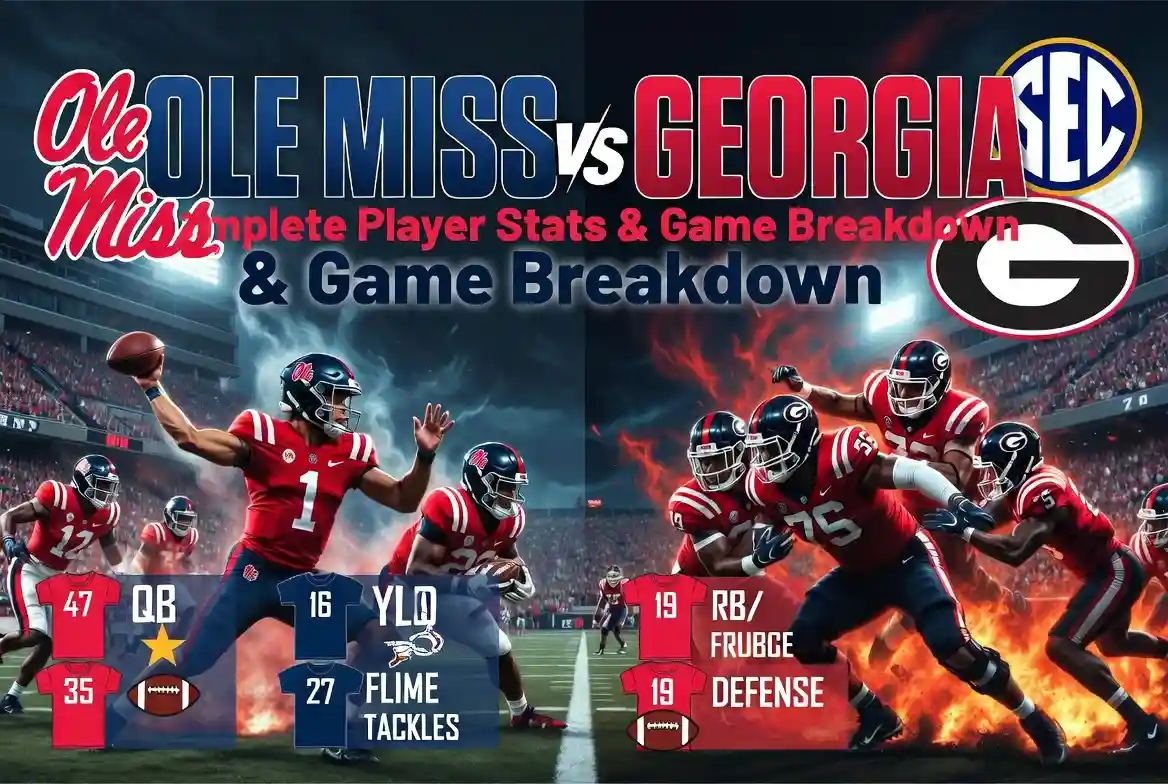
Ole Miss vs Georgia Football: Complete Player Stats and Game Breakdown
When Georgia’s Defense Showed Up, Everything Changed
Some SEC matchups reveal exactly where a program stands. The Ole Miss and Georgia football game in Athens was one of those honest tests — the kind where box scores tell a fuller story than the final whistle.
Georgia won 38–24, but the margin doesn’t fully capture how the game unfolded. Ole Miss battled back from a 14-point first-quarter deficit, briefly seized momentum, and then watched it slip away as Carson Beck and a relentless Bulldog defense took over.
Below is every meaningful player stat from both sides, with context that explains the “why” behind the numbers.
Game Flow: Quarter-by-Quarter
| Quarter | Ole Miss | Georgia |
| 1st | 0 | 14 |
| 2nd | 17 | 7 |
| 3rd | 0 | 10 |
| 4th | 7 | 7 |
| Final | 24 | 38 |
The second quarter was genuinely compelling. Ole Miss outscored Georgia 17–7 in that stretch, with Jaxson Dart finding Tre Harris on a 45-yard strike and the Rebel defense forcing a fumble. It was the kind of momentum swing that had Georgia fans shifting in their seats.
But Georgia responded the way championship-caliber programs do — with a composed third quarter that didn’t flinch. A field goal and a 60-yard touchdown pass later, the Bulldogs were back in control and never looked back.
Full Player Stats: Ole Miss Rebels
Passing
| Player | Pos | Comp/Att | Yards | TD | INT |
| Jaxson Dart | QB | 24/38 | 285 | 2 | 1 |
Dart’s final line was good against an elite secondary — 285 yards, two scores, and 7.5 yards per attempt. His one interception came late in a drive where pressure forced a rushed throw. Smael Mondon Jr. read the route before Dart finished his drop. That’s the difference between good and great at this level.
Rushing
| Player | Pos | Carries | Yards | TD | Avg |
| Ulysses Bentley IV | RB | 15 | 78 | 1 | 5.2 |
| Quinshon Judkins | RB | 10 | 47 | 0 | 4.7 |
Bentley’s 18-yard burst in the second quarter opened up the middle and set up the Rebels’ first touchdown. Judkins ran hard between the tackles but found little daylight against Georgia’s front seven. The Rebels averaged 3.8 yards per carry as a team — not enough to sustain drives when the passing game stalled.
Receiving
| Player | Pos | Rec | Yards | TD | Long |
| Tre Harris | WR | 7 | 112 | 1 | 45 |
| Jordan Watkins | WR | 4 | 62 | 0 | — |
| Caden Prieskorn | TE | 5 | 43 | 1 | 12 |
| Dayton Wade | WR | 3 | 28 | 0 | — |
Harris was the most dangerous player on the field in the first half. His 45-yard reception wasn’t just a big play — it was the spark that changed the entire complexion of the game temporarily. Prieskorn’s touchdown on a crossing route showed the flexibility in Ole Miss‘s offensive design. The tight end has become a genuine red-zone weapon.
Full Player Stats: Georgia Bulldogs
Passing
| Player | Pos | Comp/Att | Yards | TD | INT | Rating |
| Carson Beck | QB | 28/36 | 340 | 3 | 0 | 180+ |
Beck’s performance was the clearest reason Georgia won this game. He finished with a passer rating north of 180, completed 78% of his attempts, and hit throws at every depth — a 40-yarder to stretch the field, back-to-back 33-35 yard completions, and countless short-to-intermediate passes that kept chains moving. Zero turnovers. No bad decisions under pressure. It was a quarterback clinic.
Rushing
| Player | Pos | Carries | Yards | TD | Avg |
| Trevor Etienne | RB | 18 | 95 | 1 | 5.3 |
| Roderick Robinson II | RB | 7 | 29 | 0 | 4.1 |
Etienne was the engine. He didn’t break off anything explosive, but he consistently moved the pile forward and fell for extra yards on contact. His third-quarter touchdown — a 12-yard run off tackle — effectively ended the game as a contest. Georgia averaged 4.6 yards per rush, which helped them control clock and field position throughout.
Receiving
| Player | Pos | Rec | Yards | TD |
| Dominic Lovett | WR | 8 | 105 | 1 |
| Dillon Bell | WR | 5 | 73 | 1 |
| Arian Smith | WR | 3 | 49 | 0 |
| Oscar Delp | TE | 4 | 39 | 0 |
Eight different receivers caught at least one pass for Georgia. That’s not accidental — it reflects a game plan designed to stress every zone of the defense and prevent any single corner or safety from dictating coverage. Lovett was Beck’s go-to on third down. Bell’s 33-yard touchdown came on a single-coverage isolation route where he simply won.
Defensive and Special Teams Stats
| Player | Team | Tackles | Sacks | INT | FF | FR |
| John Saunders Jr. | Ole Miss | 9 | 0 | 0 | 0 | 0 |
| Malaki Starks | Georgia | 8 | 0 | 1 | 0 | 0 |
| Javon Bullard | Georgia | 6 | 0 | 0 | 0 | 1 |
| Smael Mondon Jr. | Georgia | 7 | 1.5 | 0 | 1 | 0 |
| Mykel Williams | Georgia | 5 | 2.0 | 0 | 0 | 0 |
| Jared Ivey | Ole Miss | 4 | 1.0 | 0 | 1 | 0 |
Georgia’s defensive line won the trenches. Williams recorded two sacks by beating the left tackle with first-step quickness on back-to-back third downs. Mondon’s forced fumble that Bullard recovered became a direct scoring drive for the Bulldogs. Ole Miss’s Saunders made tackles all over the field, but the Rebels simply couldn’t get stops when they needed them most.
Special Teams
| Player | Team | KR Yards | Notes |
| Barion Brown | Ole Miss | 78 | 34-yard long |
| Deantre Prince | Ole Miss | 52 | PR return yards |
Georgia’s Peyton Woodring connected on a 42-yard field goal and all five extra points. No tricks, no missed kicks — just execution. Brown gave Ole Miss decent starting field position on returns, but the Rebels couldn’t consistently capitalize. Georgia’s punt coverage was noticeably disciplined, limiting the return game throughout.
Head-to-Head Stats Comparison
| Category | Georgia | Ole Miss |
| Passing Yards | 340 | 285 |
| Rushing Yards | 136 | 160 |
| Total Yards | 476 | 445 |
| Turnovers | 0 | 2 |
| Sacks | 4 | 1 |
| 3rd Down % | 64% (9/14) | 38% (5/13) |
The total yardage gap was small — just 31 yards. Ole Miss actually out-rushed Georgia. On paper, those numbers suggest a closer game was possible. But the turnover margin and third-down efficiency tell the real story. Georgia converted nearly two-thirds of third downs. Ole Miss converted fewer than four in ten.
That’s where games at this level are won and lost.
What Actually Decided This Game
The turnover gap. Georgia scored 10 points off Ole Miss’s two turnovers. In a game decided by 14, that’s a swing of 10-17 points depending on what Ole Miss might have scored on those drives.
Beck’s clean game. A quarterback who protects the football and converts third downs consistently forces defenses to play more snaps, stay on the field longer, and eventually break. Beck never gave the Rebels a gift, and that relentlessness wore the defense down.
Red zone execution. Georgia scored touchdowns on all four red-zone trips. Ole Miss scored twice but also settled for a field goal and threw an interception inside the 20. The difference between touchdowns and three-pointers in the red zone is the entire margin of this game.
Sack differential. Four sacks put Dart in third-and-long situations repeatedly. When a defense knows a pass is coming, everything gets harder for a quarterback. The pressure disrupted timing on several drives that looked promising before third down.
Historical Context
Georgia has won 12 of the last 14 meetings in this series. The 2023 blowout (52–17) is the most recent landmark, but this game showed the Rebels have genuinely shortened the gap in talent and scheme.
Beck’s 340-yard performance ranks third all-time for a Georgia quarterback against Ole Miss. Tre Harris’s 112 receiving yards placed him among the top-five single-game receiving performances by a Rebel in this rivalry — a notable individual achievement in a losing effort.
Key Takeaways
For Ole Miss: Avoiding sacks and protecting the football in road games has to become a priority. Dart has the arm talent and mobility. The decision-making under fourth-quarter pressure is the next step in his development.
For Georgia: Beck appeared to be the version that would put Georgia in the running for the national championship. When he plays clean and distributes the ball this efficiently, stopping the Bulldogs becomes a defensive puzzle with no easy answer.
Frequently Asked Questions
Who led all passers in this game? Carson Beck finished with 340 yards, three touchdowns, and no interceptions. Jaxson Dart threw for 285 yards with two scores and one interception.
Which defenders had the biggest impact? Mykel Williams led with two sacks, while Smael Mondon Jr. added 1.5 sacks and forced a fumble. Malaki Starks had an interception and led all players with eight tackles.
Did any receiver hit 100 yards? Two did. Tre Harris finished with 112 yards for Ole Miss, and Dominic Lovett posted 105 yards for Georgia.
How did turnovers affect the final result? Georgia converted both of their takeaways into points. Ole Miss did not force a turnover, and the resulting 10-point swing proved decisive.
What was the biggest individual run of the game? Ole Miss managed a 14-yard run as its longest carry. Trevor Etienne was the most consistent on the ground for Georgia, averaging 5.3 yards per carry.
Who scored rushing touchdowns? Trevor Etienne for Georgia and Ulysses Bentley IV for Ole Miss each scored one rushing touchdown.
Stats sourced from official NCAA game records, OleMissSports.com, GeorgiaDogs.com, and SECsports.com.